
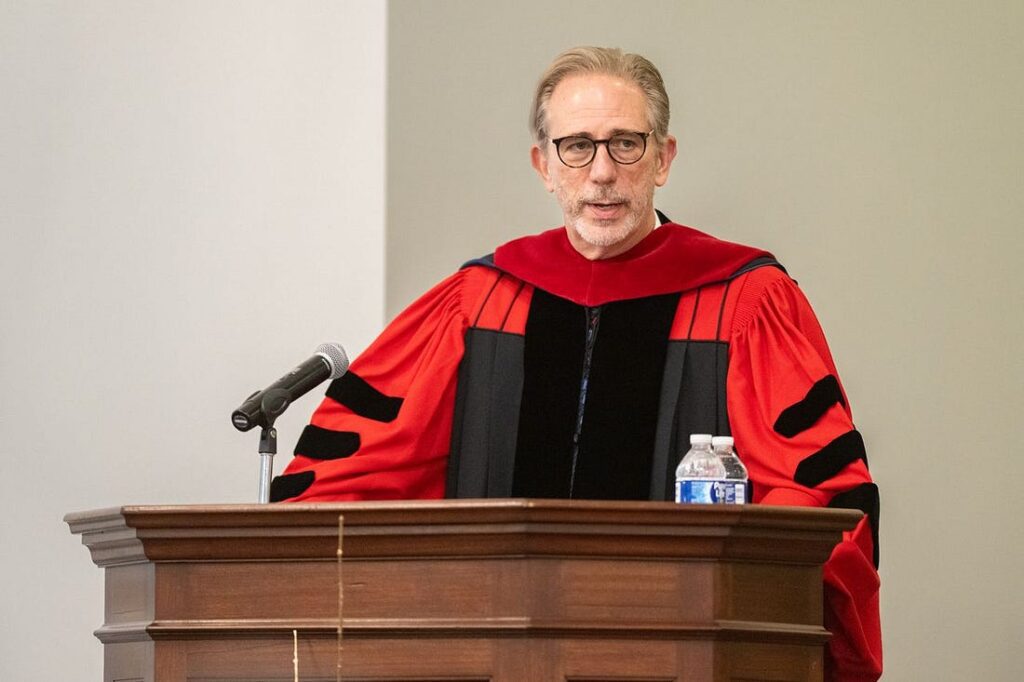
Note: On Friday, May 22, I enjoyed the distinct honor of being awarded an honorary Doctor of Divinity at Franklin College in Indiana. I also gave this baccalaureate address. It foreshadows themes that will appear in my future book with Bloomsbury on Christian humanism.
I. GREETINGS
President Prather, distinguished faculty, proud families and friends, and above all, graduates: It is a genuine honor to join you for this baccalaureate service as you mark one of life’s great thresholds.
Franklin College is one of our nation’s premier liberal arts colleges. You can be proud of meeting its rigorous academic expectations and reaching graduation. I congratulate you warmly.
II. OPENING QUESTION
Here is the question I want you to consider with me today: how will you bring the values of a liberal arts education to bear in a world increasingly dominated by the transformative power of technology? Or to put the matter even more starkly: how shall you remain human beings in a world dominated by ever more sophisticated machines? How shall you act to preserve human values?
III. OUR MOMENT: TECHNOLOGY ACCELERATING
When I began working on this address, the first thing I decided to do was to ask my AI buddy ChatGPT (we tend to call him (them?) Chat in our house) how one begins a baccalaureate address these days.
But of course Chat volunteered more information than that. Chat told me what the tone and flow needs to be in a baccalaureate address. Undoubtedly Chat would have been perfectly happy to write this address for me. I had to choose not to ask Chat to do that. I drew a line regarding where I would not allow technology to do for me what my human self needed to do for myself.
Could we just take a moment to mark, here at Graduation 2026, that all of this is quite new? The last paragraph of this address would have made no sense to you four years ago. It describes a world that did not yet exist.
Remember when you just had Google to help you search things? Google! Ha! That’s baby technology compared to what we are using now.
You and I, all of us, are living through a technological revolution. You and your teachers, like students and teachers everywhere over these last few years, have been wrestling week by week with how to manage this technology rather than being managed by it. How to remain human beings who use technology with moral purpose and limits, rather than human beings increasingly shaped and consumed by technologies whose powers now exceed our own.
And let me be clear: Chat writing papers for you is the least of our worries when it comes to AI.
Some of you may already have experienced difficulty in finding entry-level jobs. AI-driven restructuring, hiring freezes, and credential devaluation are beginning to reshape the workforce, especially for young adults just entering it.
But the deeper concerns reach far beyond employment.
AI is already accelerating a crisis of truth itself. Deepfakes and synthetic media are becoming so sophisticated that people increasingly struggle to distinguish reality from fabrication.
Authoritarian governments and corporations are expanding AI-driven surveillance capacities with extraordinary speed.
Malicious actors are using AI to generate cyberattacks and manipulate public opinion at scales never before possible.
And then there is warfare.
In conflicts around the world, “lethal autonomous warfare systems” are rapidly transforming the battlefield. Warfare is becoming increasingly algorithmic, increasingly remote, and increasingly detached from direct human accountability.
Battlefield Droids? Robots? Drones?
What only recently belonged to science fiction is becoming ordinary military practice.
The now four-year-old Ukraine war has accelerated many of these developments, as technological innovation like this has, for Ukraine, become central to national survival itself.
Feeling good so far? How about one more. Earlier this month, Anthropic co-founder Jack Clark predicted there is a substantial chance that AI systems may soon begin training successor systems with minimal human supervision. All you have to do is tell current AI to train next gen AI without further human intervention.
Some researchers now openly discuss the possibility of an “intelligence explosion” in which AI systems improve themselves at blinding speed, iteration after iteration, without human direction.
What could possibly go wrong?
These technologies may help cure diseases, expand learning, reduce drudgery, and connect human beings across vast distances.
But every technology also raises the question of what kind of people we are becoming while using it.
I am not here today to tell you to fear technology.
Every generation faces the challenge of mastering new powers without surrendering its soul to them.
Your generation’s challenge simply arrives at unprecedented scale and speed.
The real question is not whether machines will become more powerful. They will.
The real question is whether human beings will remain morally, spiritually, and relationally alive while using them.
IV: KEEPING HUMAN LIFE HUMAN
The humanist tradition, at its best, is the conviction that human beings possess intrinsic dignity, moral agency, intellectual capacity, and spiritual depth that must never be reduced to utility, profit, data, or mechanism.
Christian humanism first emerged during the Renaissance, especially in northern Europe, when scholars like Erasmus sought to recover the deepest sources of Christian wisdom—Scripture, the Church Fathers, the moral and spiritual riches of the past—in order to renew both faith and culture.
As the Christian humanist tradition developed over many centuries, it has sustained the conviction that human beings bear the image of God, and therefore are not merely intelligent animals or information-processing systems, but creatures of sacred worth, whose exalted spiritual, moral, rational, and interpersonal capacities are to be celebrated, protected, and nurtured.
Christian humanism both retrieved and produced some of our culture’s finest works of literature, philosophy, art, and history.
Christian humanism kept the memory alive of some of our culture’s most excellent lives, the great saints and sages of the past.
Christian humanism laid a foundation for democratic citizenship while also refining how to understand religion so that it could be more consistently a source of moral goodness in culture.
There’s also Jewish humanism, Muslim humanism, Buddhist humanism, and secular humanism. There are many humanisms.
You don’t have to be a Christian to celebrate and to want to experience face-to-face encounter, a highly developed conscience, the capacity for empathy and mercy and courage, the ability to remain silent, a reverence for all creation, and the instinct to bow down in worship before that (only that) which is worthy of it.
The university is one of the few places remaining in our culture in which such traditions are kept alive.
Indeed, religious humanism of this type was nurtured in the womb of both the church and the university, and over many centuries it has kept these traditions alive.
Keeping human life human means remaining open to the presence of the Transcendent. For me and for many of us, that is the God from whom we come, before whom we live, and to whom we shall return. The God whom the biblical traditions understand as Creator, Sustainer, Lawgiver, Judge and Redeemer. The idea is that humans are most likely to remain human when we live our lives before God.
V. APPLICATION
I want to offer six exhortations to you as you graduate. Each begins with an R. There will be a test.
Redevelop a more critical relationship with your technology tools – some of you are already doing it. Dating app use is down. Phone use is down. AI is viewed with skepticism. Keep seeking those dinner table conversations. Long coffees. Walks without phones.
TakeRegain control of tech, maximizing what it can do and minimizing what it must not be allowed to do Reports increasingly suggest that one reason businesses are hiring liberal arts graduates is precisely because they need human beings capable of navigating the ethics of AI implementation. This is something that only humans can do. If we fail to do it, we heighten the risk of disaster.
Refuse to invest technology tools like AI with personalities and agency. That will be hard. Because AI is starting to feel personal, and people are responding. And AI companies are giving their chatbots names and personalities.
Retrieve and continue engaging historical intellectual and moral and religious traditions. The best of the human experience. Keep the legacy of humane learning alive. Support your university as an alum as it is one of the main institutions that keeps the arts and letters alive.
Reinvest in personal encounters and relationships. Look people in the eye. Have unhurried conversations. Be a human with other humans. Many of you will enter jobs in which that is precisely what you are paid to do. You will exercise the uniquely human “soft skills” that are what sets us apart from our machines and are the least likely to be replaced..
Recall Jesus’ teaching about where God is to be found in human life. It’s in Matthew 25:31-40.
“When the Son of Man comes in his glory and all the angels with him, then he will sit on the throne of his glory. 32 All the nations will be gathered before him, and he will separate people one from another as a shepherd separates the sheep from the goats, 33 and he will put the sheep at his right hand and the goats at the left. 34 Then the king will say to those at his right hand, ‘Come, you who are blessed by my Father, inherit the kingdom prepared for you from the foundation of the world, 35 for I was hungry and you gave me food, I was thirsty and you gave me something to drink, I was a stranger and you welcomed me, 36 I was naked and you gave me clothing, I was sick and you took care of me, I was in prison and you visited me.’ 37 Then the righteous will answer him, ‘Lord, when was it that we saw you hungry and gave you food or thirsty and gave you something to drink? 38 And when was it that we saw you a stranger and welcomed you or naked and gave you clothing? 39 And when was it that we saw you sick or in prison and visited you?’ 40 And the king will answer them, ‘Truly I tell you, just as you did it to one of the least of these brothers and sisters of mine, you did it to me.’
Where do we meet God? In human faces, especially those in distress. As you did it to the least of these, you did it to me.
VI. BENEDICTION
Graduates, you are entering a world of astonishing technological power.
But your deepest calling will not be to become machines that compete with machines.
Your calling will be to become wiser humans.
You are called to become people capable of judgment.
Capable of courage, mercy, and truthfulness, love, reverence, and restraint.
Capable of seeing another human being not as data, utility, threat, audience, consumer, or avatar—but as neighbor.
The Christian tradition teaches that this capacity is holy.
Jesus said that whatever we do to “the least of these,” we do also to him.
That means that the future of human civilization will finally depend not only on what our technologies can do, but on whether we still possess the moral and spiritual capacity to recognize Christ in one another.
So protect your humanity.
Protect your capacity for attention.
Protect your conscience.
Protect your friendships.
Protect your ability to sit quietly.
Protect your ability to pray.
Protect your ability to love another person face to face.
And use every tool—including the astonishing technologies now emerging—not as a substitute for human life, but in service to it.
Congratulations, graduates. And may God guide you, sustain you, and keep you fully human, fully alive, as you leave this wonderful place and go out into the world.
Photo Credit: Chad Williams, Franklin College

