
On September 2, my next book comes out, with Orbis press. Job in Exile: A Guide for Spiritual Refugees (Orbis Books) is a treatment of the majestic, complicated, wonderful Book of Job.
I have been fascinated with Job since my high school days. It struck me then as wildly, dangerously out of step with the rest of the Bible, so much so that I was shocked that it was in there at all. Here is a guy who has everything and then has God orchestrate every possible calamity against him in order to test his faith. Job first responds with submissive piety and then starts railing in protest for 30 chapters. And then somehow the book seemed to tie up neatly with him getting replacements for everything he had lost, including his children. But he never got any real answers to his questions.
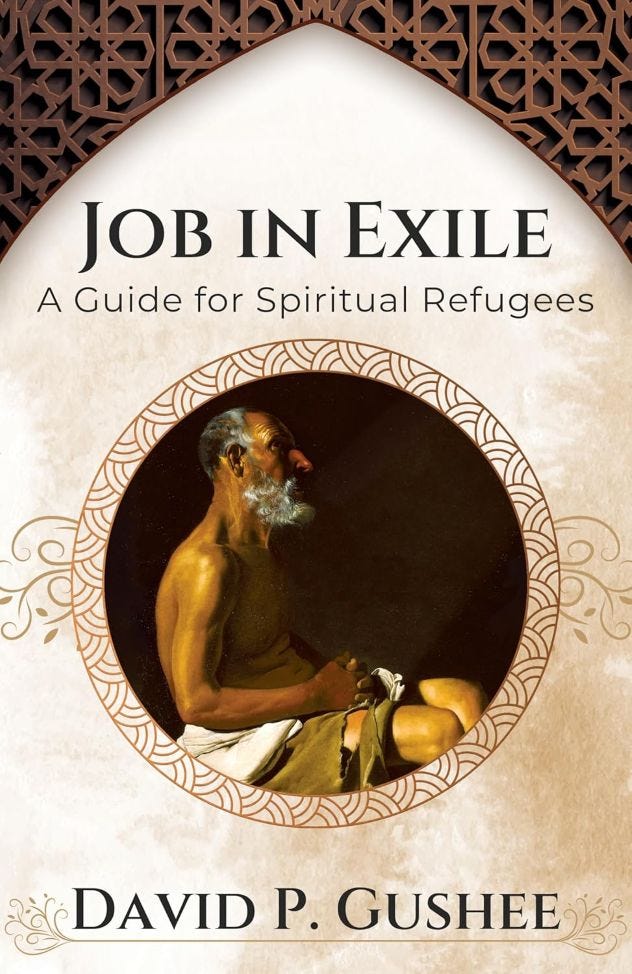
I rediscovered Job in a big way about 8 years ago, when I began teaching through the book to my longsuffering Sunday School class here in the Atlanta area. Verse by verse we slogged. It was with them that I began catching glimmers of a different way of reading Job. In that community of post-Southern Baptists, post-evangelicals, and post-closeted gay Christians, I began to see Job as a role model for dissident believers. That’s because the Job that I see now not only protests what his God has done to him, he also protests the interpretation his community puts on his suffering, and the way they do not respect the questions his suffering now forces him to ask.
So, yes, the book of Job is about multiple kinds of losses — of family, health, and prosperity. But is also about other losses, notably certainty, community, and honor. That’s because Job’s questions are not able to be received by his friends and his broader community. The more he asks them, the angrier and more contemptuous toward him do they become. As the dialogue nears its climax, it’s clear that Job’s friends have abandoned him to a fate they claim to be truly deserved.
I think Job gives us a role model — not perfect, to be sure, but still a role model — of the refusal to silence one’s questions and deny one’s experiences even when doing so costs you your religious community. And THAT is an experience that many post-evangelicals, and other spiritual exiles and refugees, well understand.
Job is a breakthrough text for such people (us!), in part because of the example offered by the character Job, but also because the book is itself a dialogue and represents dialogue with the rest of the canon. Scholars are clear that the book of Job contains numerous, sometimes sarcastic allusions to other biblical texts. And the characters in the book also articulate alternative perspectives on Job’s situation and how to make sense of it. The book of Job in itself repudiates the old idea that the Bible speaks in one voice, but its multiple voices are all worth considering. It can therefore help spiritual refugees toward a more nuanced engagement with scripture itself. We can learn to love the dialogues, the arguments, and not try to cling to a nonexistent univocality.
Oh, there’s so much more to say, and I would really like to just lay the book on you right here. For now, I will leave you with these three really nice endorsements of Job in Exile.
“Writing as a postevangelical ethicist, Gushee enters his Joban protest, not against God but against the abuses of theology and Christian community through bombastic God-talk. His close reading of the text is deeply dialogical, engaging translators, interpreters, and theologians ancient and modern, Jewish and Christian. Thus he equips “everyday readers” to accept the book’s critical challenge to live honestly, faithfully, and with compassion in the midst of our most acute suffering.”
—Ellen F. Davis, Amos Ragan Kearns Distinguished Professor of Bible and Practical Theology, Duke Divinity School
“Shakespeare’s plays are often set in contemporary contexts, thus illuminating things in both the text and ourselves. In reading the ancient biblical tale of Job as a guide for contemporary spiritual refugees, David Gushee creates the same effect. We see the complexity and profundity of this great story anew, and we gain fresh insight, compassion, and hope for those of us whose spiritual and religious journeys have been marked by change and loss. In Job in Exile, Gushee is the bible teacher, the ethicist, and the pastor the church needs today.”
-Steve Watson, Pastor, Reservoir Church, author of All Flesh Shalom: Larger, Freer, More Loving Readings of the Good News of Jesus.
“In Job in Exile, David Gushee offers a searching, pastorally attuned, and theologically rich interpretation of Job. At once a work of biblical exegesis, moral theology, and spiritual accompaniment, it unfolds not as a conventional commentary but as a series of meditations on pivotal moments that illuminate a journey through exile, protest, to the reconstruction of faith. Gushee presents Job’s witness amid inexplicable suffering as pointing to the faithfulness of relentless, even confrontational questioning of God. Drawing on a wide range of voices and traditions, Gushee’s close reading of Job refuses both reductive theodicies and brittle certainties without yielding to despair, offering instead a compelling vision of faith that can sustain solidarity, truth-telling, and hope in a fractured and wounded world.”
–Rev Canon Prof Luke Bretherton, Regius Professor of Moral and Pastoral Theology, University of Oxford
Here is a bit more about the book and how you can pre-order it. (The ebook will be available for pre-order closer to the release date of September 2.) I will be launching the book with a talk at the Wild Goose Festival.
All of my writing is for everyday readers, and not just for scholars. I am especially trying to provide resources for church use. That’s why this book has a user-friendly study guide, built into the text. It is also why I would enjoy coming to churches to preach, teach, and dialogue with you about Job once the book comes out.
Look for a few excerpts from the text here on my Substack in the next three months.

