
I mentioned in an earlier post that I am reading deeply in literature that attempts to help us understand how the US arrived at the dire political condition in which we now find ourselves — and that I will use this page to report on what I am discovering.
Today I want to tell you about a fantastic book that adds crucial depth and gravity to our understanding of the ideas and thinkers behind what the author calls the MAGA New Right. Released in November 2025, Laura Field’s Furious Minds is one of the most important books I have read in a long time.
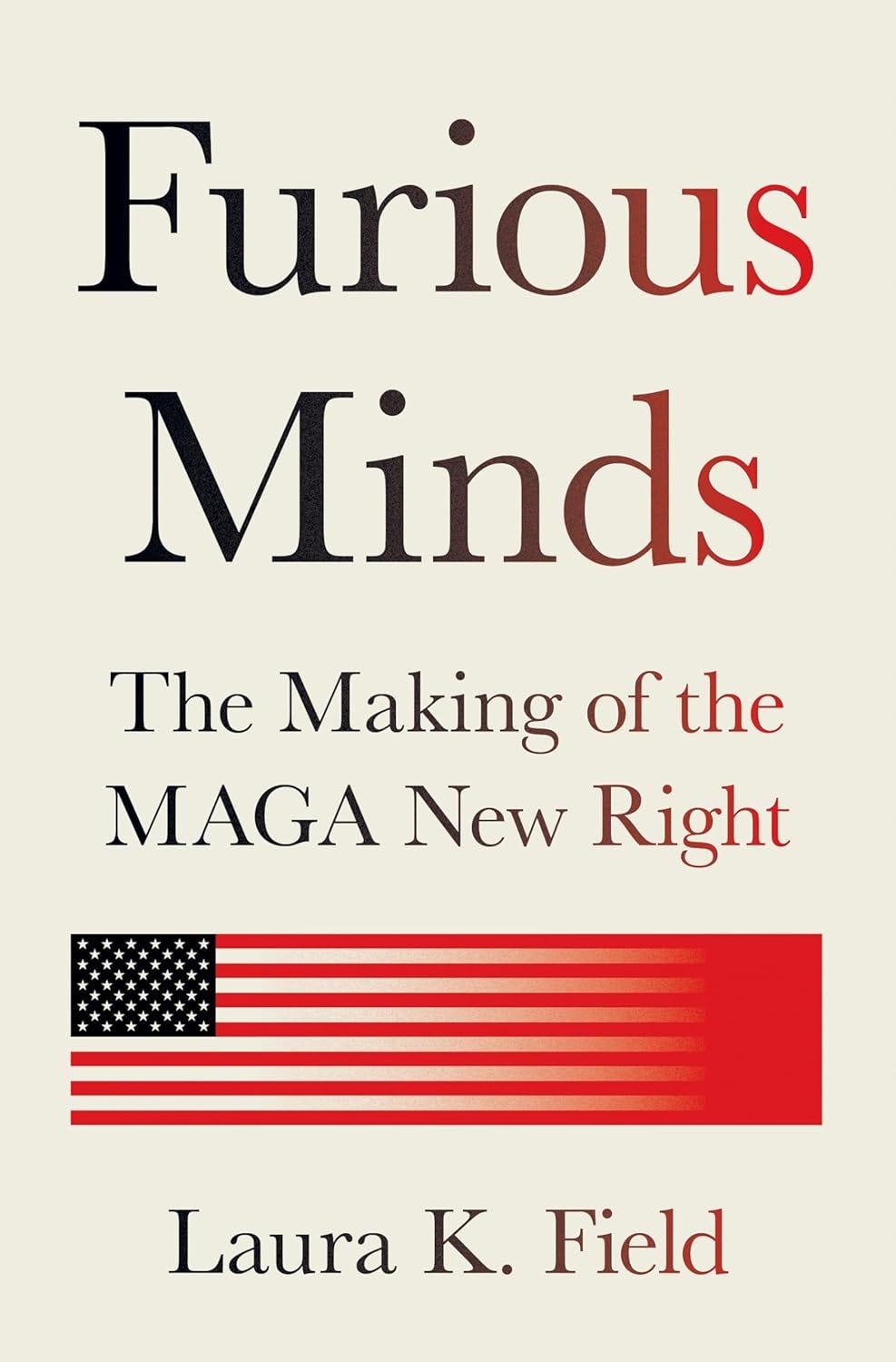
Furious Minds examines the writings and speeches of about two dozen intellectuals (or pseudo-intellectuals) on the MAGA New Right. Field has read what they have written, attended conferences they have organized, listened to their podcasts, and done the miserable work of reading the noxious online screeds of the very worst of them. A political theorist who has taught at multiple schools and written widely, Field tells us enough about herself for us to figure out that in her intellectual training and earlier sympathies she trod a path somewhat adjacent to the figures she profiles here before watching, with horror, their slide to the MAGA hard right.
She divides these men (and they are all men) into four primary categories. In the order in which she takes them on, these are the “Claremonters” — people mainly associated with the Claremont Institute in California, though their ally Hillsdale College gets attention too — the Postliberals, the National Conservatives, and the picturesquely-named Hard Right Underbelly. (You will want to hang with Field long enough to learn about such characters as Mencius Moldbug, Bronze Age Pervert, and Raw Egg Nationalist.)
The Claremonters, including Hillsdale, are mainly about restoring the greatness of the “American founding,” as they understand it, and advancing “patriotic education.”
The Postliberals are mainly about identifying the weaknesses of the liberal political and cultural order and moving to some postliberal “common good” vision.
The National Conservative movement “promotes the notion of a single, relatively homogeneous nation-state that is under threat” and needs to be protected.
The Hard Right is “distinct insofar as they are more hard-line, racist, misogynistic, and violent in their rhetoric…They push the movement ever further to the extremes.” In this latter group, some made their fame online and pseudonymously, most famously Bronze Age Pervert.
But like pretty much everyone Field examines, they are all highly educated. Most have PhDs from reputable academic programs in philosophy or political science.
After examining most of the key figures in each group, Field then adds chapters on specific moments in which the MAGA New Right figures have swung into action during the Trump Era.
Thus a chapter on “Stopping the Steal” tells us exactly what Claremont legal scholar John Eastman was arguing in order to overturn the results of the 2020 election. Eastman really was “in the room where it happens,” and if not for Mike Pence and the Capitol Police, who knows what might have happened on January 6th and thereafter.
The formidable Chris Rufo gets center stage in the chapter on the anti-CRT and pro-“patriotic education” movement. The ease with which his campaign swept the Red states brings to mind Professor Harold Hill’s opening number in “The Music Man.”
Harvard Law professor Adrian Vermuele gets nearly an entire chapter to himself for his “common good constitutionalism” project, a learned combination of Catholic integralism, antiliberalism, and authoritarian virtue ethics.
Tucker Carlson and “Raw Egg Nationalist” get featured in a chapter on the MAGA Hard Right manosphere/misogyny strand. Future House Speaker Mike Johnson and pro-Christian Nationalist Stephen Wolfe get primary attention in a treatment of Christian nationalism and revivalism. (This particular theme is relatively underplayed in this book, and there are many other treatments of it elsewhere.)
There is no substitute for going into the weeds with Laura Field and reading her book. Those with serious interest should consider tracking down some of the most important books and essays written by these men to get a deeper understanding of their arguments. Field’s sourcing is extensive and impeccable.
Here are the three most important lessons I derived from this book.
Never Underestimate Your Adversary
The movement, institutions, and figures that Field describes here are formidable and not to be underestimated. They are smart, clever, and well-educated. And there is money behind them, in part because a lot of the older conservative institutions have joined up with the MAGA New Right. Examples include the Heritage Foundation and First Things magazine. While it seems that President Donald Trump may be somewhat declining in power and energy, the figures profiled in this book, and the institutions that fund them, are not going anywhere.
This Movement is Determinedly Antiliberal
The master narrative of the Right since Brown v. Board of Education (1954) and especially since the multiple social changes of the 1960s has been that the Left has taken over American culture and government and has been shoving its liberal priorities down the throats of a “moral majority” of traditional mainstream Americans (e.g., conservative Christians). The cry of negative reaction began with Brown and has continued ever since, on women’s roles, abortion, sex, immigration, and more. Every figure mentioned in this book shares this reactionary narrative of the Left taking over and ruining everything, at every level, from K-12 schools to Hollywood to the civil service and woke business and the courts.
What has changed, as I argued in my Defending Democracy From Its Christian Enemies, is that antiliberalism now also means a willingness to undermine or directly challenge the US constitutional order, e.g., liberal democracy itself. The Left is viewed as so evil, the struggle as so Manichean, that accepting the results of elections may not matter as much as destroying the Left, once and for all.
Learned theorists are not proposing ad hoc voter suppression campaigns, but a much more serious revamp of the US constitutional order to create something like a postliberal Christian republic where a certain Christian account of virtue and the common good becomes law.
Meanwhile, down in the “hard right underbelly,” the threats of violence simmer, right out in the open — while over in certain of the explicitly Christian parts of the MAGA New Right, zealots still dream of theocracy, dominion, and holy war.
The Open Question of Whether Americans Still Believe in Liberal Democracy
Furious Minds leaves me with profound worries, beginning with the 2026 and 2028 elections. Field decisively demonstrates that the ideas, institution, precedents, and people are in place to fiddle with the election process and results — if the citizens of this country let them. Donald Trump, that great election denier, is still president, after all.
And JD Vance is Vice President — and may well preside over the count on January 6, 2029 as to whether he himself will be certified as president. If Field is right, Vance is a deep adherent to the ideas of the MAGA New Right, an integral part of these networks. Would he be as committed to honoring the election results, even if he (his side) lost, as Mike Pence was? Or could he make an argument to himself that something more important than vote-counting was at stake?
Will the people of the United States of America — as individuals, as election administrators, as government officials like secretaries of state and governors, as electors in the electoral college, as lawyers, as judges adjudicating the inevitable upcoming lawsuits — demonstrate that we still believe in liberal democracy, even if our side loses?
Most of the men profiled in Laura Field’s extraordinary book have offered reasons to doubt what their answer would be. Given their influence, that is very frightening indeed. But they are just one part of us, not all of us, not a majority of us.
What will the rest of us do?

