
I have a growing stack of books that all, in one way or another, aim to answer the question, “How in the world did we get to the point where Donald Trump became president twice and has dominated our politics for ELEVEN ENDLESS YEARS?!”
Each of these “how did we get here” books pinpoints different forces, figures, and moments that the author believes to be pivotal. There are so many of them that it can be difficult to keep up with them all. I will engage several more in weeks to come.
But today I want to tell you about a disturbing and illuminating book that traces our crisis to the very specific period of the early 1990s. The book is called When the Clock Broke: Con Men, Conspiracists, and How America Cracked Up in the Early 1990s. Its gifted author is the political commentator and writer John Ganz.
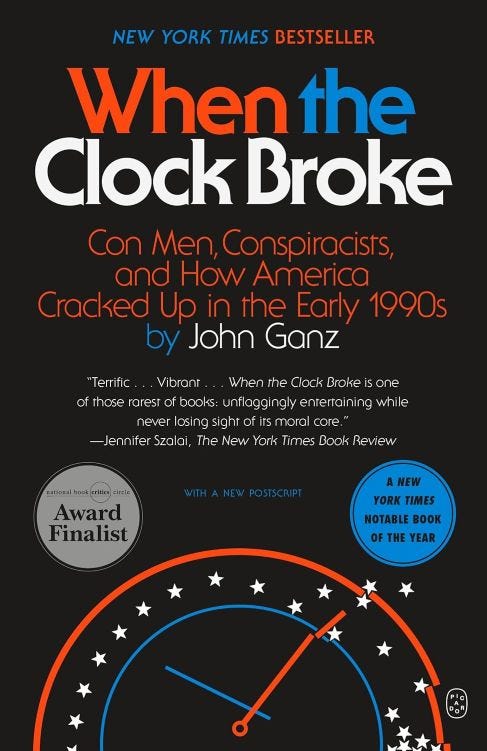
Ganz’s thesis is that we got here via the “crackup” that occurred in the early 1990s. To make his case, he takes us on a highly detailed and deeply depressing tour of what was going on in that period.
Trumpist America did not just drop from the sky. It had been brewing for a long time.
For those of us old enough to have been politically aware during that time, it is uncanny and instructive to be taken on a time machine back to that very short but very important season, from the end of the George H.W. Bush presidency to the election of Bill Clinton. I remember much of what happened during this period, but I had not thought of that time as decisive in laying the groundwork for where we are now.
And for those of you young whippersnappers whose political memory is much shorter, the book should be extremely illuminating in a different way. It helps to establish that Trumpist America did not just drop from the sky — or erupt from below. It had been brewing for a long time.
Ganz argues that the early 1990s was a kind of in-between time. The Cold War had just ended in American triumph, and the rise of Islamist extremism was not quite visible yet. Ronald Reagan had proclaimed “morning in America,” but many felt after eight years of his presidency that night had fallen on them — those who had lost everything when their banks collapsed, their jobs were shipped overseas, or their farms foreclosed during what was described as a long recession but amounted to a permanent economic restructuring.
It did not feel like morning in America to those who lived in fear of surging crime, or of racist policing. Nor was it a hopeful time to those lacking health care, tied to jobs that were gone or government policies that had faced cutbacks or elimination in the name of budget balancing or supply-side economics.
The story of America’s crackup, on Ganz’s telling, begins not in the 2010s but in the hinge years of 1991–1992.
Nor, to mine a darker vein, did it feel like morning in America to many white people who felt that society was no longer for them (or under their control), some of them holding supercharged resentments based on the perception of bias against them both as white and as (some kind of traditionalist) Christian.
This was also an era in which presidency after presidency was perceived to have failed. Even some Republicans described George H.W. Bush as a failed president, certainly by the end of his term. He was so weak as to be challenged by both Pat Buchanan from his right (he gets massive, deserved attention in this book), and then by Ross Perot, who was the most successful third-party candidate in a century, and whose largely mythic self-presentation gets considerable attention here.
Bush was succeeded by Bill Clinton, who was bitterly opposed by most Republicans, and was succeeded by George W. Bush, who was bitterly opposed by most Democrats, and who ended with dismal approval ratings.
Overall, Ganz shows that the (perceived) failure, lies, and scandals of the two primary political parties helped open the door to the con men, conspiracists, and other trolls who emerged during this hinge period in US history.
Here are some of the key figures Ganz discusses in that roll call. Ready?
- David Duke, former Grand Wizard of the Ku Klux Klan and neo-Nazi from Louisiana, who got elected to the state legislature and made serious runs for both Governor and Senate. Duke’s history and racist message proved repeatedly accepetable to majorities of white voters in Louisiana, including white evangelicals and fundamentalists.
- Pat Buchanan, the highly articulate voice of America First isolationism, white resentment, and religious-moral culture wars, who challenged George H.W. Bush during his reelection campaign, garnering around a third of the GOP vote in multiple primaries before dropping out.
- Ross Perot, the Texas businessman who for a time led the three-way presidential race in the summer of 1992.
- Daryl Gates, who ran the LA Police Department during the era that produced the Rodney King beating, acquittal of the four police officers, and massive subsequent riots.
- John Gotti, the New York mafioso who became a folk hero to many when facing off against prosecutors multiple times.
- Randy and Vicki Weaver, the displaced Iowa farmers who ended up becoming fanatical Christian survivalists and whose deadly square-off with the FBI at Ruby Ridge, Idaho became fodder for even deeper radicalization of a violent right-wing fringe.
- Rush Limbaugh, who helped pioneer coast to coast conservative talk radio with its legions of loyal listeners.
I knew and remembered all these names, but perhaps Ganz’s most significant accomplishment is rediscovering right-wing intellectuals and writers who were articulating the credo of “Middle American Revolution” when only a small number of people were paying attention. These included Sam Francis and Murray Rothbard. The extensive quotations from these men are absolutely chilling in light of current events.
This was Sam Francis after the 1992 election, which went to Bill Clinton:
What is really amazing about American society today is not that there is so much violence and resistance to authority but that there is so little, that there is not or has not long since been a full-scale violent revolution in the country against the domination and exploitation of the mass of the population by its rulers. A people that once shot government officials because they taxed tea and stamps now receives the intrusions of the Internal Revenue Service politely; a society that once declared its independence on the grounds of states’ rights now passively tolerates federal judges and civil servants who redraw the lines of electoral districts, decide where small children will go to school, let hardened criminals out of jail without punishment, and overturn local laws that are popularly passed and have long been enforced…If there remain today any Americans who are not sheep, they’ll stop trying to hire phony populist gunfighters to save them from the wolfish bandits who run the country and in the next four years they’ll start learning how to shoot for themselves (p. 368).
This is a semi-mainstream political commentator, who had a column in the Washington Times, calling for insurrection. Note the grounds: a populist resentment of the federal government, states’ rights (code for resistance to civil rights laws), education policy (looks like a nod to school busing for racial desegregation), law and order against hardened criminals, local control, etc.
Read this book and ask yourself not simply how Donald Trump emerged, but how the conditions that made him possible were decades in the making.
It was all there by the early 90s. This is what Ganz is not just arguing but showing. The aggrieved white lower- and middle-class, nursing their economic resentments and losses, leaning into backlash against immigration, civil rights mandates, multiculturalism in education, and Hollywood and entertainment industry proselytizing for liberal values. Middle-American revolutionaries attracted to phony populists (like Perot and later Trump, both billionaires), with a significant religious dimension at times becoming apocalyptic, an armed fringe either retreating to their compounds or preparing for the revolution, and a surprisingly large part of the population pulling for the rebels and Mafiosi rather than the existing regime.
On this telling, the story of America’s crackup doesn’t trace to the 1960s, as many authors would suggest; nor is it the later 1990s and the rise of Newt Gingrich, nor the 2010s and the Tea Party followed by the rise of Trump. It was 1991-1992.
Whether or not one accepts every aspect of Ganz’s thesis, he succeeds in demonstrating that today’s political conflicts did not emerge overnight. They have deep roots, long memories, and recognizable predecessors. Understanding those roots is indispensable if we hope to understand the America we inhabit today.

