
André Trocmé, Le Chambon, and the refusal to surrender moral judgment
There are basically three kinds of people who know what happened in the small French village of Le Chambon during World War II.
The first group is Jewish survivors of the Holocaust, and their descendants, who remember with gratitude and awe the fact that this little village of a few thousand people saved several thousand Jews from annihilation, a number comparable to or greater than the population of the village itself. The greatest work of art and tribute to come out of that community is Pierre Sauvage’s luminous 1989 film, “ Weapons of the Spirit.” That film is etched in my soul, because…
I am a part of the second group who know about what happened in Le Chambon. That group consists of those who have studied Christian rescuers of Jews during the Holocaust. I joined that small community of scholars when I wrote my dissertation on such rescuers at Union Theological Seminary in New York. Published in 1994 as The Righteous Gentiles of the Holocaust , that study set the course of my career. It may also have saved my faith, lacerated as it had become in studying the Holocaust itself.
The third group is the Chambonnais themselves, and their descendants. Never wanting to call attention to themselves, generally motivated by a strong Christian duty ethic, they believed that they had simply done what God and basic humanity required of them. In interviews, they look uncomfortable, not wanting the attention.
This Substack is reader-supported. To receive new posts and support my work, consider becoming a free or paid subscriber.
I want every one who reads my work to know about what happened in Le Chambon. I want every human to know. I certainly want every Christian human to know — and to study deeply the lessons of that time, that place, and that community.
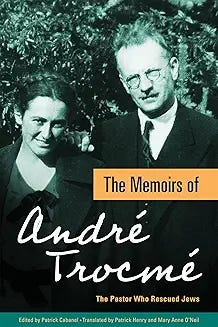
For those of us in these three related communities, the release of Pastor André Trocmé’s memoirs comes as a major event. Trocmé was the pastor of the Protestant (Reformed) temple (church) in Le Chambon during World War II. He was the primary leader who articulated the Christian motivation for the open rescue of Jews in defiance of Vichy French and German authorities, some of them quite nearbyy.
The small, remote village of Le Chambon was not seen as an especially desirable “pulpit.” These memoirs reveal that Trocmé ended up there in part because he was unwanted elsewhere. The main reason he was unwanted was because of his resolute Christian pacifism, a principled commitment to nonviolence about which Trocmé never wavered and which made him deeply unpopular among most of the leaders and many of the people of his largely non-pacifist denomination.
But the placement — one dares to say providential placement — of Trocmé in the mountain village of Le Chambon from 1934 forward, together with his associate pastor Édouard Theis, school leader Roger Darcissac, and dozens of other like-minded people, put the characters in place who were willing and able to lead their community in the hiding (and care) of a massive number of Jewish refugees during the Holocaust.
And it wasn’t just these men. It was, as Trocmé’s spitfire wife Magda said in Sauvage’s interview with her for his film, a“consensus général” that the Jews must be saved and by no means betrayed to the authorities. The rescue of Jews was a community-wide effort. No one person can be treated as responsible for it.
There are by now several significant books on Le Chambon, and on the Trocmé family. The first, Lest Innocent Blood Be Shed , was published by Philip Hallie in 1979. In these books and in some articles, some snippets from Andre’s previously unpublished diary were included.
But only now, with first the publication of his memoirs in French in 2020, and now in English in 2025, do we have André Trocmé’s (nearly-complete) memoirs. (He stopped writing them well before the end of his life, so they don’t cover his later years.) In an unexpected gift to the reader, we also are offered notes from Magda written onto the manuscript and occasionally included here by way of clarification or correction of what her husband wrote.
The editor, Patrick Cabanel, and the publisher, Plough Books, have also added a handful of other documents produced by André Trocmé at pivotal moments of his narrative, such as a few key sermons and letters during WWII.
In the end, the manuscript is a gold mine for understanding the character, life journey, and motivations of André Trocmé. I am so thrilled that it now is available to English readers.
André Trocmé (1901-1971) was raised in comfort but cold religious strictness in the French Protestant (Reformed/Huguenot) tradition. His family was large and had both German and French ancestry. The family’s comfort and security were shattered by the First World War. The war came to their town in northern France; their house was occupied and damaged; they witnessed considerable carnage and death. André’s pacifism was born during this catastrophe, a not entirely unusual development but more enduring for Trocmé than for most wartime pacifists.
The Trocmé family was forced to leave France and became refugees living under very tough conditions in Belgium. Eventually André studied theology at the Protestant Faculty of Theology in Paris, was conscripted into the army where he refused to carry a weapon, and spent a study year at Union Seminary in New York. There two really important things happened — André served as a tutor to two sons of John D. Rockefeller, and he met and fell in love with an Italian woman named Magda Grilli.
Upon returning to France, André entered local parish ministry. Throughout the book we hear much about his functioning as a pastor in different church contexts. He appears to have been a very conscientious pastor but over time a gradually disillusioned one. He reports meaningful experiences of heartfelt religious renewal, but he also reports the way these experiences eventually burn out. He describes considerable infighting among the Protestant clergy over doctrinal matters. He reports frustrations with power brokers in local congregations and the denomination. His judgments of other people, by name and post, are frank and unsparing.
But Trocmé suffered so much. This must be understood. The reader can sense that he was worn out by life after the dramatic events of WWII, which included not just the events of the war itself, but numerous tragedies, including the tragic death of his adolescent son Jean-Pierre, his own imprisonments and near-death experiences, and numerous personal and church setbacks. Those of us used to thinking about the Trocmé family through the gauzy lens of heroism now read this honest self-assessment:
In relating the crises experienced by the Collège Cévenol, I have succumbed to the sadness that engulfs me when I discover the accumulated ruins of my life: the emotional ruins from the accidental death of my mother; the material ruins of the house where I was born in Saint-Quentin; the family ruins after the deaths of Jean-Pierre and, later, my son Daniel; the ruins of an educational enterprise begun in faith and joy that ending (sic) up being just another institution (p. 414).
As I contemplate this long memoir, what strikes me is that the primary through-line is not the rescue of Jews during the Holocaust, which occupied a relatively brief period of time in the life of André Trocmé. Even in the several chapters that deal with the war years, the rescue of Jews occupies a relatively small amount of the memoirist’s attention. It is as if it all occurs off-stage, and indeed, it did, by design — the Jews were hidden, secretly, in remote locations for the most part.
When Trocmé writes of the war years, we learn about so many other things, including pastoral struggles, issues with the local school, personality conflicts, family challenges, and local headaches. But above all we learn of the struggle to survive in a wartime environment first under collaborationist Vichy French officials, then under the thumb of the marauding Germans, then in prison, then back home but with the emergence of enemy paramilitaries, and then the rise of French resistance fighters (also quite dangerous), and then the chaos after D-Day, when it takes a scorecard to keep track of all the people with guns and all the stupid deaths.
This is a reminder that among the occupational hazards of studying the Holocaust is that one can tend to zero in so tightly on what the Nazis were doing to the Jewish people, or trying to do, in a given location, that you kind of forget everything else that was going on during a massive social and political and human crisis in the same place at the same time.
If one were to ask André Trocmé himself what his life was about, taken as a whole, it is clear that his answer would be his commitment to Christian nonviolence. Trocmé was constantly in trouble with someone — church authorities, political authorities, men with guns — because he would not hate whom everyone else hated, and he would not kill whom everyone else at that place and time said it was appropriate to kill. And he would not, as a pastor, allow anyone, from church or state, tell him what he could teach or preach about this or any other matter.
The following is the most important quote from the entire book. Trocmé reports it as a statement he made to a fellow Frenchman at the end of the war, a man who had changed sides multiple times and made much trouble for Trocmé . The statement reflects his characteristic bluntness, and is worth quoting at length:
What astounds me in your case and that of many of our colleagues…is the continuous, opportunistic change of convictions. I’m sure it’s unconscious. For my part, when I was very young, I had the privilege of becoming a believer in nonviolence. This put me in opposition to all violence and kept me from making many errors. I was:
—opposed to the anti-German hatred prevailing in France in 1918. For this, I was branded a Communist in 1927.
—opposed to nascent Nazism in Germany. People claimed I was a French propagandist come to hoodwink the Germans.
—opposed to the run-up to the war. I was accused of complicity with Hitler.
—opposed to the war in 1940. You denounced me as an agent of the fifth column, then as a clandestine Italian Fascist because of my wife.
—a resister against the German occupation and Vichy’s subjection to Germany. You denounced me as an English agent, then American, then Jewish, then Communist again.
—opposed to the retaliation against German prisoners. Once again, I was considered a “Kraut in disguise.”
I was simply trying to be a good Christian. It was public opinion that fell from one kind of violence into another, from one form of collaboration with evil into another (pp. 393-394).
“I was simply trying to be a good Christian.”
André Trocmé had one lodestar moral belief, rooted in his commitment to Jesus Christ, and he stuck with it. That belief was that Christians must not kill. This conviction also meant that they must prevent killing where they can, and take risks where they must, to save life.
For Trocmé, it was always about Christian nonviolence.
This nonviolence was not sentimental idealism. It functioned as a discipline of resistance to tribal moral capture.
We live in a time of profound moral confusion. Christians are among those who appear to have lost their heads, swinging around like kites in the wind in response to public opinion and the political passions of the moment.
We need immovable moral convictions if we are not to just blow with the wind.
André Trocmé’s nonviolence was not passivity. It was a refusal to surrender moral judgment to nationalism, war fever, vengeance, or ideological conformity.
In this, he has a great deal to teach us.

